
The industry feels two factors have played a role in improving the offtake and reducing trade inventory - one is that the supply chain in pharmaceuticals has more or less stabilised, and secondly, with lockdown curbs easing and OPDs opening, some demand has grown at the consumer end as well.
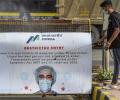
With projections suggesting the number of cases in the city will touch 75,000 by the end of May, civic authorities are working overtime to add to the number of beds.

Cipla is among the three Indian companies that signed a non-exclusive licensing agreement with US-based Gilead Sciences to make and distribute the latter's repurposed Ebola drug Remdesivir in 127 countries including India.
Experts pointed out the move will only help taxpayers temporarily, as the tax liability remained the same and the date for advance tax has not been extended.

Most feel as the movement of people normalises, the in-patient volumes in hospitals will grow and by the end of May, occupancy should be around 50 per cent, and 75 per cent over a period of time.

Pharma companies gear up for the 'new normal' as they train and align their sales forces for a paradigm shift. GSK leads the charge with staggered return-to-work, others plans yoga sessions and health care webinars for salesperson's family.
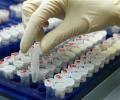
Researchers at Northwell Health in New York are testing the effects on Famotidine (used in high intravenous doses) on Covid-19 patients as a potential treatment. After the hospital announced its clinical trials, it led to a drug shortage in the US. Back home, however, there has not been any surge in the demand for Famotidine yet.
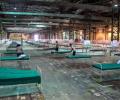
The hospital, in the commercial hub of Bandra-Kurla Complex, will serve as an isolation facility for non-critical COVID-19 patients. Expected to be ready in a fortnight, the new makeshift facility can be scaled up to 5,000 beds, if needed. The Brihanmumbai Municipal Corporation will run the hospital that will have, among other things, oxygen facilities and pathological laboratories. Sohini Das reports.

No change in retail prices as oil marketing firms to absorb increase
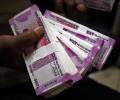
Without accounting for refunds, however, the collection contracted 5.4 per cent, indicating muted economic activity as the Covid-19 pandemic and subsequent curbs paralysed most sectors.

Although there is no government order to this effect, chemists decide to not dispense medicines for cold, cough and fever over the counter.
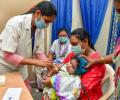
A dipstick survey covering 30 villages in Rajasthan threw up some worrisome numbers. About 250 children missed their regular vaccination schedule in March alone. These numbers are alarming, since India has around 600,000 villages according to the 2011 census. Sohini Das reports.

'The numbers are null and void now. Look, we can give out projections now, but we know that a week later those numbers will also be irrelevant. So we need to wait,' a top government official said.

A government official said out that with hardly any economic activity, an immediate duty hike will not be productive and could be announced once the lockdown eases and demand revives.

Officers across departments and ministries have been asked to speak to people across sectors for 'SWOT' analysis of issues for revival of the economy.
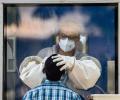
Mumbai, with an estimated population of nearly 20 million, has been testing 1,200-1,400 people per day. Delay in the delivery of rapid antibody test kits has forced the BMC to restrict its testing net.

Can Interferon alfa-2b treat COVID-19 effectively?
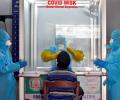
Cadila, Biocon developing rapid antibody testing kits; Eris, Mylan, Gland importing. There are two kinds of testing for the novel coronavirus - the real-time polymerase chain reaction test kit that uses throat or nasal swabs and provides results in a few hours, and the other is antibody-based rapid testing kit that use blood samples and provides results in a few minutes.
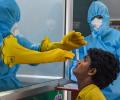
Private diagnostic laboratories have already approached the respective state governments and the municipalities where they are operating to approve protocols for such testing in clusters, reports Sohini Das.
Direct tax collections missed the revised target for 2019-20 by Rs 1.42 trillion at Rs 10.27 trillion, an 8 per cent fall over the previous year.
